
The first month is particularly important because many of the decisions you make during this period can make the following months much easier—or considerably more complicated. Administrative requirements, housing, banking, healthcare, transportation, communication, and social connections often overlap, meaning one missing document or unfinished task can delay several others. That is why having a clear first 30 days abroad checklist can make such a difference. This guide takes you through the most important things a new expat should consider during the first month, from the first few days after arrival to the point where you should ideally have established a stable daily routine.
Why Your First 30 Days Abroad Matter
The first month is not about having everything figured out immediately. It is about creating a strong foundation. Depending on the country and your immigration status, you may need to register your residence, validate a visa, obtain identification documents, arrange healthcare, open a bank account, sign a rental contract, register for utilities, or complete tax-related procedures. Some countries also have strict deadlines for specific immigration or residence procedures. For example, official French guidance recommends that expats check the administrative requirements applicable to their situation and complete relevant procedures after arrival. At the same time, there are practical tasks that may not appear on any official checklist but are essential to everyday life. You need to know:
Where your nearest supermarket is
How public transportation works
Where to find a pharmacy
How to contact emergency services
Which documents you need for everyday administration
How to pay bills and receive your salary
Where to find reliable local services
How to communicate with people in your new community
The goal is not perfection. The goal is to become independent enough that everyday problems no longer feel like emergencies.
Before You Start: Create Your Expat Document Folder
Before tackling the individual tasks, create one secure location for all important documents. Keep both physical and digital copies of documents such as:
Passport
Visa or residence permit
Birth certificate
Marriage or family documents, if applicable
Employment contract
University acceptance or enrolment documents, if applicable
Rental agreement
Proof of address
Health insurance documents
Driving licence
Tax documents
Banking information
Save digital copies in secure cloud storage and keep another backup somewhere separate. Official relocation guidance also recommends scanning or photographing important documents so they remain accessible while abroad. This simple step can save hours of frustration later.
Days 1–3: Focus on Immediate Essentials
The first three days should be about getting comfortable enough to function. You do not need to solve your entire life immediately.
1. Confirm Your Accommodation
Make sure you have a secure place to stay and understand the conditions of your accommodation. If you are staying in temporary housing, check how long you can remain there and start planning your next step immediately. If you have rented a long-term property, keep copies of your lease and any documents provided by your landlord. Your address may become one of the most important pieces of information during your first month because it can be required for banking, government registration, healthcare, utilities, and other services.
2. Get a Local SIM Card or eSIM
A local phone number can become surprisingly important. You may need it for:
Bank verification
Government websites
Healthcare appointments
Food and delivery services
Transport applications
Landlords and estate agents
Two-factor authentication
If your phone supports eSIM, it may be possible to activate a local plan quickly without visiting a physical shop.
3. Find Essential Local Services
Spend your first few days learning your immediate neighbourhood. Locate:
The nearest supermarket
A pharmacy
An ATM
A public transport station
A medical centre or GP
A police station or relevant local authority
Your nearest embassy or consulate
You do not need to memorise everything. Save the important locations on your phone.
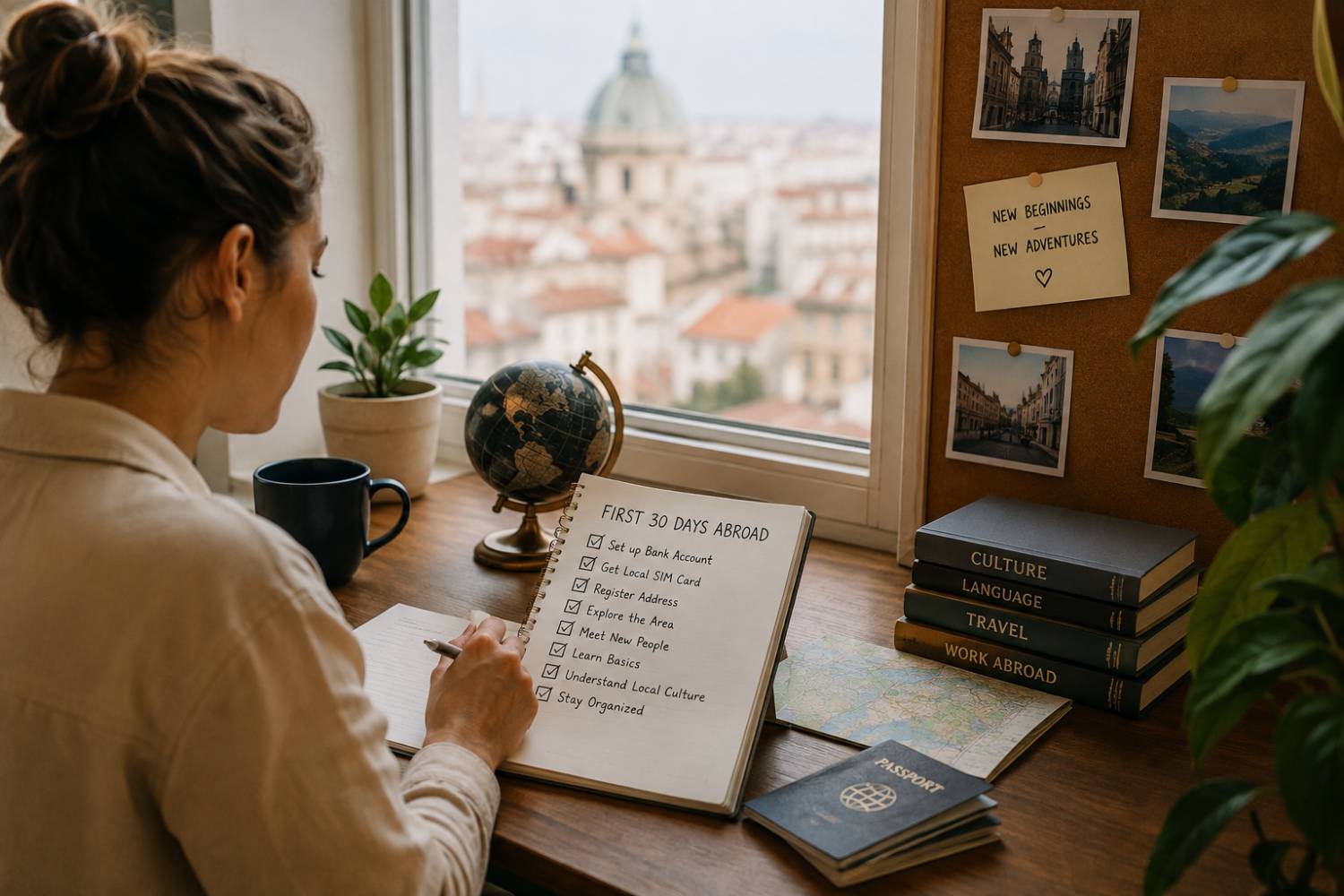
4. Keep Emergency Cash Available
Even if you normally use cards or mobile payments, keep a small amount of local currency available. Your first days may involve unexpected expenses such as transportation, deposits, groceries, SIM cards, taxis, or administrative fees.
Days 4–7: Start the Administrative Process
Once you have settled into your immediate surroundings, start dealing with official paperwork. The exact requirements depend heavily on the country, visa type, nationality, and length of stay, so always check the relevant government authority for your destination.
5. Complete Residence Registration
Some countries require newcomers to register their address or residence with a local authority. Do not assume that having a visa automatically completes every administrative requirement. Check:
Whether registration is mandatory
Where you need to register
Which documents are required
Whether there is a deadline
Whether your landlord needs to provide documentation
In several countries, residence or address registration can affect subsequent administrative procedures, so it is worth prioritising.
6. Check Your Immigration Status
Review your visa or residence permit carefully. Write down:
Expiry date
Renewal deadline
Conditions attached to your status
Work restrictions
Travel restrictions
Reporting or registration requirements
Do not rely solely on memory. Put important deadlines in your calendar with reminders several weeks or months in advance.
7. Organise Your Proof of Address
Proof of address is one of the documents that can unexpectedly become a major obstacle for new expats. Depending on the country and institution, acceptable documents might include a rental agreement, utility bill, official residence certificate, or another recognised document. This matters because proof of address may be requested when opening accounts, registering for services, applying for insurance, or completing official procedures.
Why Banking Can Be One of the Biggest First-Month Challenges
Opening a bank account sounds simple until you actually try to do it in another country. Banks may request several documents, including identification, proof of residence, tax information, employment details, or a local telephone number. This creates a common problem for newcomers: you need an address to open an account, but you may need an account to make certain housing or administrative arrangements. If you are researching this issue in more detail, see No Proof of Address, No Bank Account? for a closer look at this common expat problem.
8. Start the Bank Account Process Early
Do not wait until you urgently need a local bank account. Ask the bank exactly which documents they require before making an appointment. Depending on the country, you may need:
Passport or national ID
Visa or residence permit
Proof of address
Tax identification information
Employment contract
Proof of income
Local phone number
If a traditional bank cannot open your account immediately, investigate whether a regulated digital banking alternative is appropriate for your situation.
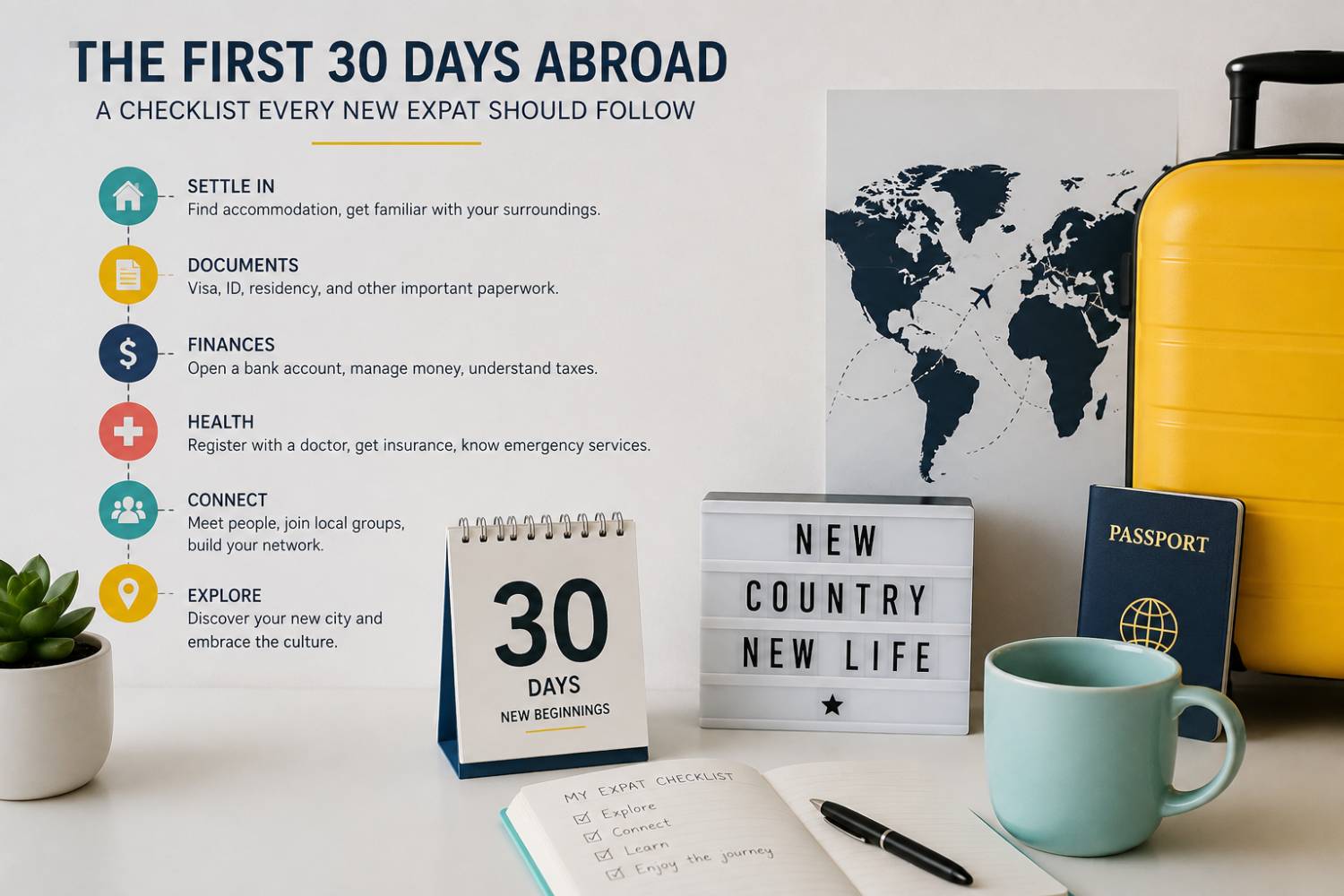
9. Understand Why Banking May Take Longer Than Expected
One of the biggest mistakes new expats make is assuming that having money automatically means they can access every banking service immediately. Banks have identification and compliance requirements, and international customers may face additional checks. For more context, read Why Opening a Bank Account Abroad Can Be Harder Than You Expect. Do not leave banking until the final week of your first month.
Days 8–14: Build Your Financial and Healthcare Foundation
By the second week, you should move beyond basic survival and start establishing systems that support your everyday life.
10. Set Up Your Main Payment Method
Once you have access to a suitable local account, organise the payments you are likely to make regularly. These may include:
Rent
Utilities
Internet
Mobile phone
Transportation
Insurance
Subscriptions
Check whether direct debit, bank transfer, card payments, or another method is commonly used in your destination.
11. Create a First-Month Budget
Your first month abroad is rarely representative of your normal monthly expenses. You may have to pay:
Housing deposits
Furniture costs
Transportation expenses
Administrative fees
Insurance
SIM and internet costs
Household essentials
Unexpected relocation expenses
Create two budgets: Setup budget: the money required to establish your new life. Monthly budget: your expected ongoing expenses once everything is running normally. This distinction makes it easier to understand why the first month can feel unusually expensive.
12. Register for Healthcare
Healthcare systems vary dramatically from one country to another. Find out:
Whether you are automatically covered
Whether you need to register
Whether private insurance is required
How to obtain your health card or identification number
How to find a primary care doctor
How prescriptions work
How emergency healthcare works
For example, international students arriving in France may need to complete social security registration and provide documents such as identification, proof of enrolment and banking details depending on their circumstances. Never assume that the healthcare system works exactly like the one in your home country.
13. Find a Local Doctor and Pharmacy
You do not have to wait until you become ill. Find a nearby doctor or medical centre and identify a pharmacy in your neighbourhood. If you take regular medication, check whether your prescription is recognised locally and whether the medication is sold under a different brand name.
Days 15–21: Make Your New Life Functional
By the third week, your attention should shift toward creating a sustainable daily routine.
14. Set Up Internet and Utilities
If these are not already included in your accommodation, arrange:
Electricity
Gas, where applicable
Water, where applicable
Internet
Mobile services
Keep confirmation emails, contracts, customer numbers and invoices in your document folder. These documents may later serve as proof of address or be useful when cancelling or changing services.
15. Learn the Local Transport System
Learn how to travel between:
Home
Work or university
Supermarkets
Healthcare facilities
Government offices
Airports and train stations
Find out whether your city offers monthly passes, contactless payments, travel cards, or discounted fares. The sooner you understand transportation, the more confidently you can explore your new environment.
16. Get Familiar With Your Neighbourhood
Do not spend your entire first month inside your apartment completing paperwork. Walk around your neighbourhood. Find a café, park, supermarket, library, gym, community centre, or other place where you feel comfortable spending time. Small routines can make an unfamiliar city start feeling like home.
17. Learn Basic Local Phrases
Even if you live somewhere where English is widely spoken, learning a few phrases in the local language can make everyday interactions easier. Focus on practical language:
Greetings
Asking for directions
Ordering food
Shopping
Making appointments
Explaining basic problems
Asking someone to repeat something
You do not need to become fluent in your first month. The goal is confidence, not perfection.
Days 22–30: Build a Routine and Social Network
The final week of your first month should be about moving from “new arrival” to “resident”.
18. Establish a Weekly Routine
Create a basic schedule around:
Work or study
Exercise
Shopping
Household tasks
Language learning
Social activities
Relaxation
A predictable routine can make an unfamiliar environment feel much less chaotic.
19. Start Building Your Social Circle
Loneliness is one of the less-discussed challenges of moving abroad. You may have a job, apartment and bank account and still feel disconnected. Look for:
Expat communities
Language exchange groups
Sports clubs
Professional networking groups
Local events
University communities
Volunteering opportunities
Do not put pressure on yourself to make close friends immediately. Start with repeated interactions. Familiarity often develops naturally over time.
20. Explore Local Support Services
If you are struggling with bureaucracy, language barriers, relocation logistics or finding reliable local services, do not assume you have to handle everything alone. Platforms such as Hebosa can be useful for expats who need assistance navigating services, communication and practical situations in a new country. Having access to someone who understands both the local environment and the needs of international residents can save significant time and reduce unnecessary stress.
Common Mistakes New Expats Make During the First Month
A good checklist is not only about what you should do. It should also help you avoid common mistakes.
Trying to Complete Everything in One Week
Relocation is a major life transition. Some processes will take days, while others may take weeks or longer. Prioritise tasks based on their dependencies and deadlines instead of trying to finish everything simultaneously.
Ignoring Administrative Deadlines
Some immigration and registration procedures have strict deadlines. Keep a dedicated calendar for official requirements and check government websites rather than relying on information from social media groups.
Assuming Every Country Uses the Same Documents
A document accepted by a bank or government office in your home country may not be accepted abroad. Always check the exact requirements of the organisation you are dealing with.
Spending Too Much on Temporary Convenience
It is easy to spend heavily on taxis, restaurants, short-term accommodation and convenience services during the first few weeks. Some of these expenses are unavoidable, but creating a simple budget can prevent them from becoming a long-term financial problem.
Staying Only Within the Expat Bubble
Other expats can provide valuable support, but interacting only with people from your own country can slow your integration. Try to maintain a balance between international communities and local connections.
Your First 30 Days Abroad: Complete Checklist
Use this condensed checklist to track your progress:
☐ Confirm accommodation
☐ Organise passport and immigration documents
☐ Scan important documents
☐ Get a local SIM or eSIM
☐ Find essential services nearby
☐ Check residence registration requirements
☐ Check visa or residence permit deadlines
☐ Obtain acceptable proof of address
☐ Start the local bank account process
☐ Organise your payment methods
☐ Create a first-month budget
☐ Arrange healthcare registration
☐ Find a doctor and pharmacy
☐ Set up internet and utilities
☐ Learn the local transport system
☐ Learn basic local phrases
☐ Explore your neighbourhood
☐ Establish a weekly routine
☐ Join at least one social or community activity
☐ Save important local emergency numbers
☐ Review unfinished administrative tasks before Day 30
What Should Be Completed by Day 30?
You do not need to have your entire new life perfectly organised by the end of the first month. However, you should ideally have the foundations in place. By Day 30, aim to have:
A stable or realistic housing plan
A working local phone number
A clear understanding of your immigration status
Important documents safely stored
A working banking solution or an active application
A healthcare plan
A manageable budget
Reliable transportation options
A basic understanding of your neighbourhood
At least a few social or community connections
A list of remaining administrative tasks and their deadlines
If some items are still incomplete, do not panic. Some administrative processes naturally take longer than 30 days. The important thing is knowing what remains outstanding and what you need to do next.
Final Thoughts: Your First Month Is About Building a Foundation
The first 30 days abroad can feel like a mixture of excitement, paperwork, uncertainty and discovery. You may have days when everything feels easy and other days when something as simple as opening a bank account or understanding a government form becomes unexpectedly difficult. That is normal. Instead of expecting yourself to immediately feel at home, focus on building stability one step at a time. Secure your accommodation. Organise your documents. Understand your immigration requirements. Set up communication and banking. Arrange healthcare. Learn how transportation works. Create a routine. Then gradually start building relationships and discovering the culture around you. The first month is not a test of how quickly you can adapt. It is the foundation for everything that comes after it. If you approach it with a practical checklist, realistic expectations and the willingness to ask for help when necessary, your transition into expat life can become significantly smoother—and much more enjoyable.
Frequently Asked Questions
1. What should I do immediately after moving abroad?
Start with the essentials: confirm your accommodation, secure a local phone connection, organise your immigration documents, check residence registration requirements, and make sure you have access to money. After these immediate needs are handled, begin banking, healthcare and other administrative processes.
2. How long does it take to feel settled after moving abroad?
There is no universal timeline. Many expats become comfortable with basic daily life within the first few months, but feeling completely settled can take considerably longer. Housing, employment, language skills, social connections and familiarity with local systems all influence the process.
3. Why is opening a bank account abroad sometimes difficult?
Banks may require documents such as proof of address, immigration documents, tax information, employment details and local contact information. Requirements vary between countries and banks, so it is best to check the exact documentation before applying.
4. What documents should a new expat keep with them?
Keep your passport or identification document, residence permit or visa, proof of address, healthcare information and other essential documents accessible. However, avoid carrying every original document with you every day. Keep secure digital backups and store important originals safely.

