
But there is a gap between translating words and truly communicating, and that gap becomes obvious the moment the situation matters. A doctor's appointment, a legal meeting, a business negotiation, or a difficult family conversation is not the same as asking for directions to a train station. This article looks at what translation apps do well, where they consistently fall short, and why human interpreters remain essential in situations that carry real consequences.
How Translation Apps Actually Work
Most modern translation apps rely on machine translation models trained on large amounts of text and speech data. They are genuinely impressive at matching patterns: given an input phrase, they predict the most statistically likely translation based on everything the model has seen before.
This works well for:
Simple, common phrases
Single words or short questions
Casual travel situations, such as ordering food or asking for a price
Getting the general gist of a written message
It becomes far less reliable when:
The sentence is ambiguous or relies on context outside the text itself
Tone, formality, or emotional nuance matters
The subject involves specialised terminology, such as medical or legal language
Real-time, two-way spoken conversation is required, with interruptions, overlapping speech, or unclear audio
Machine translation is a tool for converting words. Interpreting is a skill for conveying meaning, and those are not the same task.
What Human Interpreters Do That Apps Cannot
1. Understand Context, Not Just Words
Language rarely works word by word. The same sentence can mean different things depending on who is speaking, to whom, and why. A trained interpreter listens to the whole conversation, not just the current sentence, and adjusts their interpretation based on what has already been said and what the situation calls for. An app processes each input in relative isolation and has no real understanding of the broader conversation.
2. Read Tone, Emotion, and Intent
A patient describing pain, a witness recounting an incident, or a business partner expressing hesitation is communicating far more than the literal words. Tone of voice, pauses, and emphasis all carry meaning. Human interpreters are trained to notice this and reflect it appropriately in the other language. Translation apps generally translate flatly, without registering emotional weight or subtext.
3. Handle Ambiguity and Idiom
Every language contains idioms, indirect phrasing, and culturally specific expressions that do not translate literally. A skilled interpreter recognises when a phrase should not be translated word for word and finds the equivalent meaning instead. Machine translation frequently renders idioms literally, producing sentences that are grammatically correct but meaningless or confusing in the target language.
4. Manage Real Conversations, Not Just Text
Real conversations involve interruptions, overlapping speech, unclear pronunciation, background noise, and people changing their minds mid-sentence. A human interpreter can ask for clarification, slow a speaker down, or manage turn-taking so that both sides are understood. An app cannot intervene in a conversation; it can only process what it is given, and it struggles when audio is unclear or when two people speak at once.
5. Apply Subject-Specific Knowledge
Medical, legal, technical, and business language all have precise terminology where a small error changes the meaning significantly. An interpreter with relevant experience knows the correct terms and how they are used in that field. A general-purpose translation app is not trained specifically for these contexts and can produce translations that sound plausible but are technically wrong, sometimes in ways a non-expert would not catch.
6. Maintain Confidentiality and Professional Conduct
Professional interpreters typically follow codes of conduct around confidentiality, impartiality, and accuracy, particularly in healthcare, legal, and business settings. This matters when sensitive personal, medical, or commercial information is being discussed. A translation app has no professional accountability and, depending on the app, may process and store the data you input.
7. Adapt to the Person in Front of Them
A good interpreter adjusts their pace, phrasing, and level of formality depending on who they are working with, an anxious patient, a formal courtroom setting, or a relaxed business dinner. This kind of real-time adaptation requires judgment that current translation technology does not have.
Where Translation Apps Fall Short: Real Examples
A medical consultation. A patient tries to describe symptoms using a translation app. The app translates the words correctly, but does not catch that the patient is minimising how much pain they are actually in, a nuance a human interpreter might notice and gently probe further, since accurate symptom description directly affects diagnosis.
A legal meeting. A person uses an app to understand a solicitor's explanation of their rights. Legal language is dense and deliberately precise, and a mistranslated term, such as confusing "may" with "must," can change the person's understanding of an obligation entirely.
A business negotiation. Two sides use an app to communicate proposed terms. The app translates numbers and phrases correctly but misses the indirect, face-saving way one party is expressing disagreement, a nuance common in many business cultures, leading the other side to believe there is agreement when there is not.
A family emergency abroad. Someone needs urgent help navigating a hospital or police process. Stress and unclear speech patterns make the audio harder for an app to process accurately, while a human interpreter can stay calm, ask clarifying questions, and manage the conversation as it unfolds.
When Translation Apps Are a Reasonable Choice
None of this means translation apps are without value. They are genuinely useful for:
Quick, low-stakes travel situations, such as reading a menu or a street sign
Getting the general meaning of a short message or email
Basic, one-off phrases when no interpreter is available and the stakes are low
Supplementing, not replacing, a human interpreter during preparation
The key distinction is stakes and complexity. The lower the stakes and the simpler the exchange, the more acceptable an app becomes. The higher the stakes, whether medical, legal, financial, or emotional, the more a human interpreter's judgment, accountability, and contextual understanding matter.
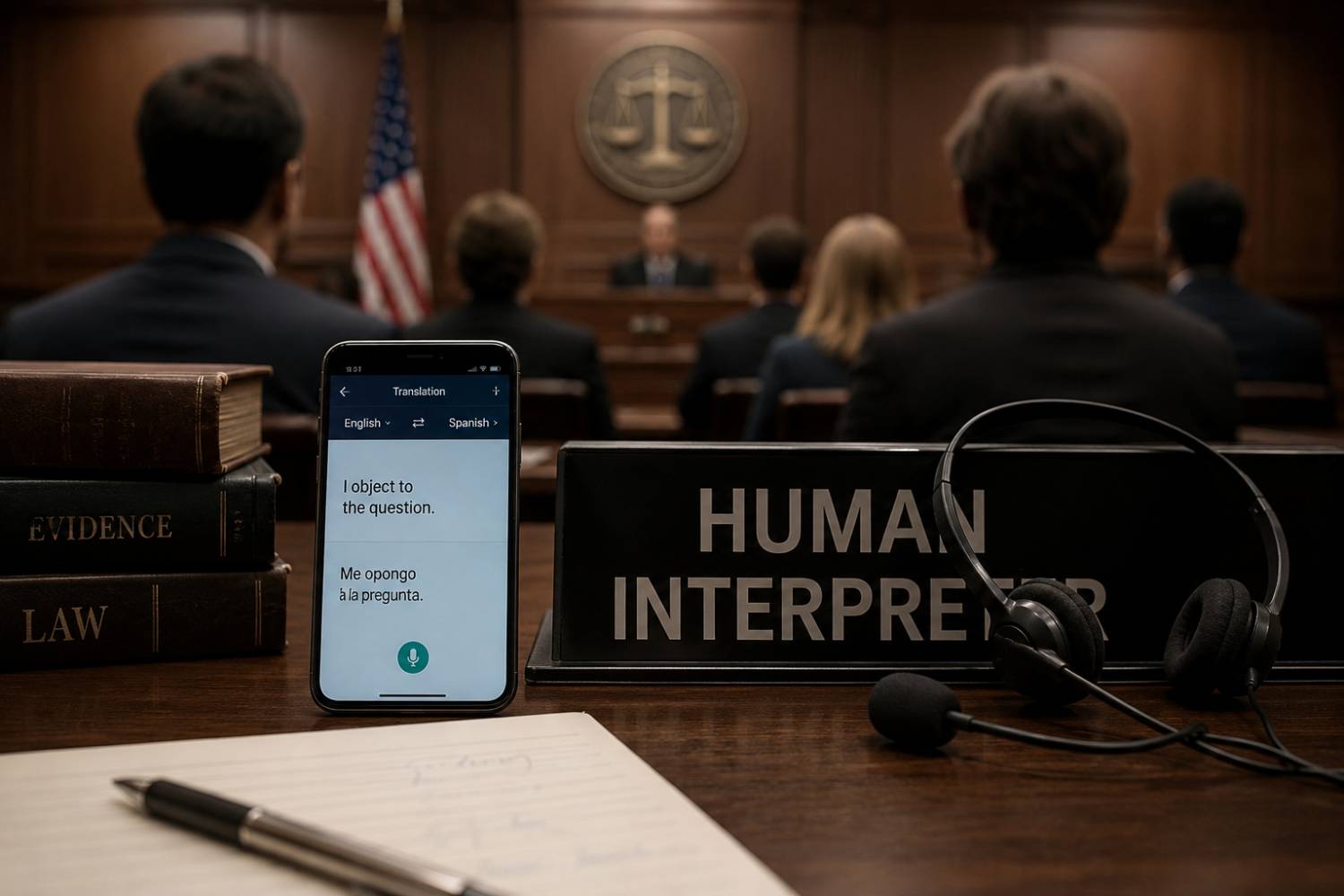
How to Decide Between an App and a Human Interpreter
A few questions can help clarify which is appropriate for a given situation:
What happens if something is misunderstood? If the consequence is minor, an app may be fine. If it could affect health, legal standing, or a business relationship, a human interpreter is the safer choice.
Is the conversation two-way and real-time? Apps generally handle one-directional or short exchanges better than fluid, back-and-forth conversation.
Does the subject involve specialised terminology? Medical, legal, and technical discussions benefit from an interpreter with relevant experience.
Is confidentiality important? If sensitive personal or business information is involved, a professional interpreter's confidentiality practices matter.
Is tone or emotional nuance part of the message? If how something is said matters as much as what is said, a human interpreter is better equipped to convey it.
Finding a Human Interpreter When You Need One
For situations where the stakes are real, whether that is a medical appointment, a legal matter, or an important business meeting, a professional interpreter offers a level of understanding, judgment, and accountability that current translation technology cannot fully replicate. This applies across languages and settings, from Spanish Interpreter Services and German Interpreter Services to more specific regional needs such as Interpreter Services in the UK.
Platforms like Hebosa exist to make finding that kind of support more straightforward, connecting people with local interpreters and language professionals in different countries, so that when the conversation truly matters, there is a qualified person behind it rather than just an algorithm.
Conclusion
Translation apps have real value, and they will likely keep improving. But translation and interpreting are not the same task. Interpreting requires understanding context, reading tone, managing real conversation, and applying judgment, none of which current apps can fully deliver. For everyday, low-stakes situations, an app is a convenient tool. For anything involving health, law, business, or genuine emotional weight, a human interpreter remains the more reliable choice.
If you are facing a situation where clear, accurate communication actually matters, visit Hebosa to connect with a qualified local interpreter rather than relying on an app alone.
Frequently Asked Questions
1. Can translation apps fully replace human interpreters?
No. Translation apps are useful for simple, low-stakes phrases, but they struggle with context, tone, idioms, and real-time conversation. Human interpreters bring judgment, subject knowledge, and confidentiality practices that current apps cannot replicate, especially in medical, legal, or business settings.
2. Are translation apps accurate enough for medical or legal situations?
Generally, no. Medical and legal language involves precise terminology where small errors can change meaning significantly. Translation apps are not specifically trained for these contexts and can produce translations that sound correct but are technically wrong. A qualified human interpreter is the safer choice in these settings.
3. When is it okay to use a translation app instead of an interpreter?
Translation apps work reasonably well for low-stakes, simple situations, such as reading a menu, asking for directions, or getting the general gist of a short message. The lower the stakes and the simpler the exchange, the more acceptable an app becomes.
4. Why do human interpreters understand context better than AI translation tools?
Human interpreters follow an entire conversation, not just isolated sentences, and take into account tone, emotion, cultural context, and the relationship between speakers. Translation apps process input largely in isolation and have no real understanding of the broader conversation, which limits their ability to convey full meaning.


