
German Interpreter Services
Businesses, hospitals, courts, and event organizers across the world increasingly need reliable German interpreter services to bridge communication gaps with German-speaking clients, patients, partners, and audiences. Whether the setting is a boardroom negotiation, a medical consultation, a courtroom hearing, or an international conference, the quality of interpretation directly shapes the outcome. A skilled interpreter does more than convert words from one language to another — they carry tone, intent, and cultural nuance across the language barrier in real time.
This guide explains what German interpreter services are, the different interpretation modes available, the industries that rely on them most, and the criteria that separate a dependable provider from a risky one. Along the way, we'll look at practical guidance for choosing a service that fits your specific situation, whether you need a single one-hour session or ongoing multilingual support for a growing organization.
What Are German Interpreter Services?
German interpreter services connect German speakers with speakers of other languages through a trained human intermediary who converts spoken (and sometimes signed) language in real time. Unlike translation, which deals with written text and can be revised before delivery, interpretation happens live and requires the interpreter to think, listen, and speak almost simultaneously. This makes professional German interpretation a distinct skill set, built on years of language training, subject-matter study, and practice under pressure.
Certified Interpreters vs. Bilingual Staff
A common mistake organization make is assuming that any bilingual employee can act as an interpreter. In reality, certified German interpreters go through formal assessment of their accuracy, terminology command, ethics, and confidentiality standards — something ad-hoc bilingual staff rarely have. For legal, medical, or official government interactions in particular, using a certified interpreter isn't just best practice; it can be a compliance requirement, since inaccurate interpretation in these settings carries real legal and safety risk.
Types of German Interpretation Services
Not all interpretation works the same way. The right mode depends on the setting, the number of participants, and how much time can be dedicated to the exchange.
Simultaneous Interpretation
In simultaneous interpretation, the interpreter renders the message into the target language almost instantly while the speaker is still talking, typically using headsets and booths. This mode is standard for large conferences, multilingual panels, and live broadcasts, where pausing for translation would break the flow of the event.
Consecutive Interpretation
Here, the speaker pauses after a few sentences so the interpreter can relay the message. Consecutive interpretation is common in smaller meetings, depositions, medical consultations, and one-on-one business discussions, where accuracy and nuance matter more than speed.
Over-the-Phone and Video Remote Interpretation (OPI/VRI)
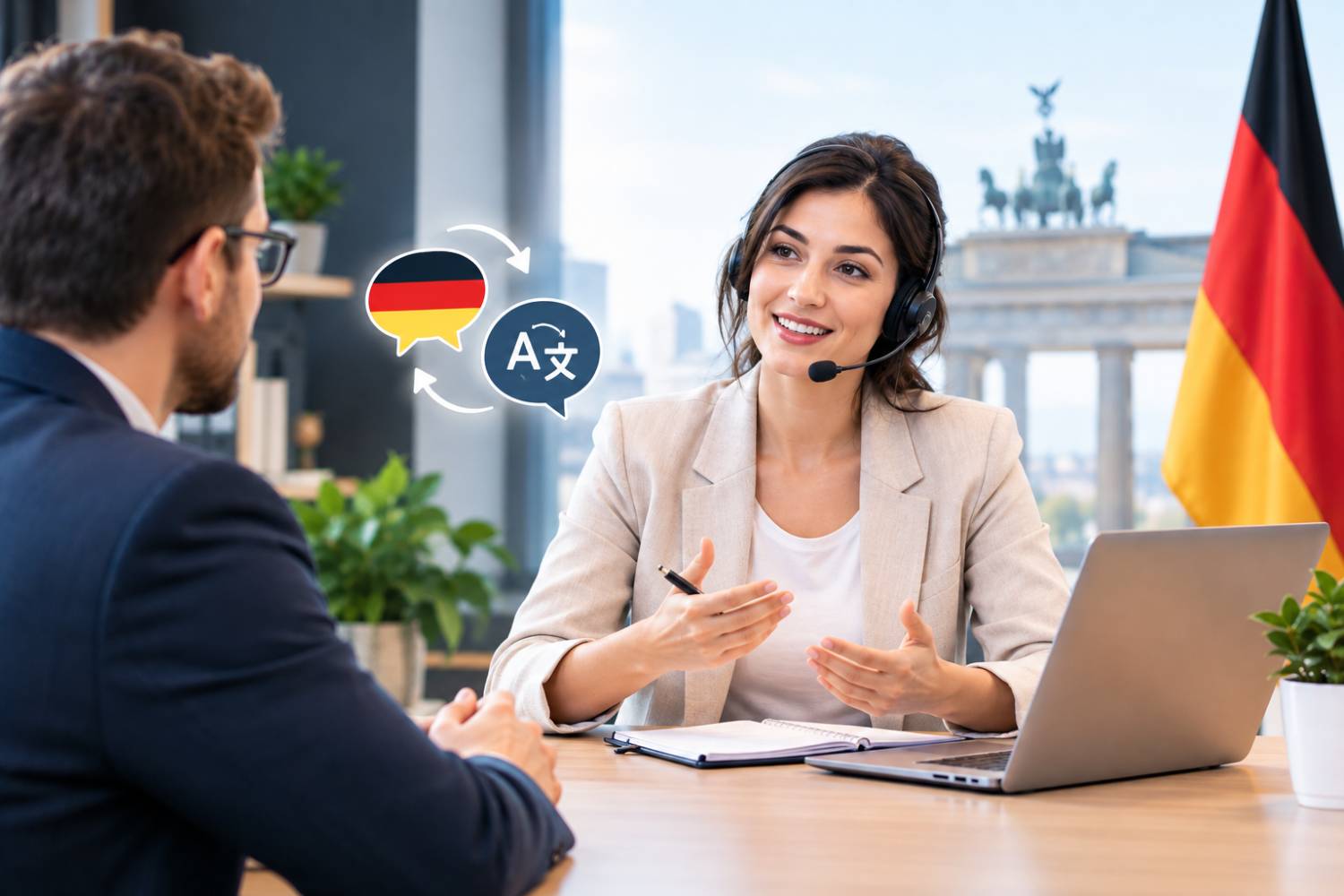
Remote interpretation, delivered by phone or video call, has become one of the fastest-growing segments of the industry. It allows organizations to connect with a qualified German interpreter within minutes, without geographic constraints — useful for urgent hospital intakes, customer support calls, or short-notice business calls with German-speaking partners.
When Do You Need a German Interpreter?
Business and Legal Settings
Contract negotiations, mergers, arbitration hearings, depositions, and notarizations involving German-speaking parties all demand precise, legally defensible interpretation. A single mistranslated clause or misunderstood term can alter the outcome of a deal or a case, which is why companies expanding into German-speaking markets (Germany, Austria, Switzerland, and Liechtenstein) typically build interpreter access into their standard operating procedures.
Medical and Healthcare Settings
Clear communication between patients and providers is critical to safe care. Hospitals and clinics use German interpreters for intake forms, diagnosis discussions, informed consent, and follow-up instructions, reducing the risk of miscommunication that could affect treatment.
Conferences, Trade Shows, and Events
International trade fairs, academic conferences, and product launch often draw a mixed audience of German and non-German speakers. Simultaneous interpretation lets every attendee follow the program in real time, which is especially valuable at events where Germany, Austria, or Switzerland are key markets.
Travel, Tourism, and Government Services
Immigration interviews, court appearances, notarized document signings, and tourism-related services also frequently require a qualified interpreter, particularly when one party's understanding of German (or the local language) is limited.
Dialect and Regional Considerations: Germany, Austria, and Switzerland
"German" is not a single uniform language in practice. Standard German (Hochdeutsch) is the norm for business and legal documents, but everyday spoken German shifts significantly across regions. Austrian German carries its own vocabulary and administrative terminology, while Swiss German (Schwiizerdütsch) differs from Hochdeutsch enough that many Swiss speakers effectively operate in two registers — one spoken at home and one used in writing and formal settings. An interpreter working across these markets needs more than textbook fluency; they need familiarity with regional idioms, formality conventions, and country-specific legal or medical terminology.
This matters most in cross-border business: a company negotiating simultaneously with partners in Munich, Vienna, and Zurich may need an interpreter (or a small team of interpreters) comfortable moving between these variants without losing precision. When booking German interpreter services, it's worth confirming which German-speaking country or region the assignment involves, since providers often match interpreters based on this detail.
Remote vs. On-Site German Interpretation: Which Should You Choose?
Both delivery formats have a place, and the right choice depends on the nature of the interaction rather than convenience alone.
• On-site interpretation is generally preferred for courtroom proceedings, high-stakes negotiations, multi-day conferences, and situations involving sensitive documents or physical evidence that benefit from an interpreter being present in the room.
• Remote interpretation (phone or video) works well for shorter consultations, customer support, routine medical appointments, and any situation where speed of access matters more than physical presence — such as an emergency room intake at 2 a.m.
• Hybrid setups are increasingly common at conferences, where an on-site interpreter handles the main stage while remote interpreters support breakout sessions in parallel.
As a general rule, the more legally or medically consequential the conversation, and the more parties involved, the stronger the case for on-site interpretation. Routine, time-sensitive, or lower-stakes exchanges are usually well served by remote options at a fraction of the cost.
What Drives the Cost of German Interpreter Services
Interpretation pricing is rarely a flat rate, and understanding the variables helps you budget accurately and compare quotes fairly.
• Mode of interpretation: Simultaneous interpretation typically requires two interpreters working in shifts (since the cognitive load is intense) plus equipment, making it more expensive per hour than consecutive or remote interpretation.
• Subject matter: Legal, medical, and technical assignments command higher rates due to the specialized terminology and liability involved.
• Session length and minimums: Many providers charge a minimum booking (often one or two hours) even for shorter assignments.
• Location and travel: On-site assignments outside a major city may include travel time and expenses; remote interpretation avoids this entirely.
• Urgency: Last-minute or after-hours bookings are typically priced at a premium compared to sessions scheduled in advance.
How to Prepare for a Session With a German Interpreter
A little preparation on your side significantly improves the accuracy and flow of an interpreted conversation:
• Share any relevant documents, agendas, or terminology lists with the interpreter in advance, especially for technical, legal, or medical assignments.
• Brief the interpreter on the purpose of the meeting and any sensitive topics that may come up.
• Speak in clear, moderately paced sentences, and pause naturally to give a consecutive interpreter room to work.
• Avoid idioms, regional slang, or humor that may not translate cleanly — or flag them to the interpreter ahead of time.
• For remote sessions, test audio and video quality beforehand to avoid dropped words during the actual conversation.
How to Choose the Right German Interpreter Service
With interpretation quality directly affecting business, legal, and medical outcomes, choosing a provider is not a decision to make on price alone. Consider the following factors:
• Certification and proven proficiency: Look for interpreters certified by recognized bodies or with documented professional experience in German-language interpretation.
• Industry specialization: Medical, legal, and technical interpretation each require specific terminology. A generalist interpreter may struggle with specialized vocabulary under time pressure.
• Availability and response time: For urgent needs, confirm whether the provider can supply an interpreter on short notice, including remote options.
• Confidentiality and data handling: Especially important in legal and medical contexts, where sensitive information is discussed.
• Track record and client reviews: A provider with a consistent history of accurate, professional service reduces risk for your organization.
Platforms such as Hebosa connect businesses, healthcare providers, and legal teams with vetted interpreters across multiple language pairs, including German, making it easier to source qualified support without building an in-house language department from scratch.
Benefits of Working With a Professional German Interpreter Service
Partnering with an established interpretation provider — rather than relying on informal, unverified help — brings several concrete advantages:
• Accuracy under pressure: Trained interpreters maintain precision even in fast-moving or emotionally charged conversations.
• Cultural fluency: Beyond vocabulary, professional interpreters understand tone, formality levels, and cultural context that shape how a message lands.
• Reduced legal and compliance risk: Certified interpretation creates a defensible record for regulated industries.
• Scalability: Agencies and platforms can supply interpreters for one-off needs or ongoing, high-volume support as an organization grows into new markets.
For teams that need interpretation alongside document translation — contracts, medical records, or marketing materials — working with a single provider like Hebosa can simplify vendor management while keeping terminology consistent across spoken and written communication.
Frequently Asked Questions
1. What is the difference between a German interpreter and a German translator?
An interpreter works with spoken language in real time, while a translator works with written text and has time to review and revise their work. Some professionals do both, but the skill sets — and often the certifications — are distinct.
2. How much do German interpreter services typically cost?
Pricing varies based on the mode of interpretation (simultaneous, consecutive, or remote), the interpreter's certification level, the industry (legal and medical assignments often cost more due to specialized terminology and liability), and the length of the engagement. Remote interpretation is generally more affordable than in-person, on-site interpretation.
3. Can I use video remote interpretation (VRI) for legal or medical appointments?
Yes. VRI is widely used in courts, hospitals, and clinics, and many jurisdictions accept it as equivalent to in-person interpretation, provided the interpreter is properly certified and the connection quality supports clear communication. It's especially useful when an in-person German interpreter isn't available locally on short notice.
4. Do I need a certified interpreter, or is a bilingual staff member enough?
For casual or low-stakes conversations, a bilingual staff member may suffice. For legal proceedings, medical consultations, contract negotiations, or any situation with regulatory or safety implications, a certified interpreter is strongly recommended — and in some jurisdictions, legally required — because of the accuracy and accountability standards involved.
5. How quickly can I book a German interpreter for an urgent need?
Turnaround depends on the provider and the mode of interpretation. On-demand phone interpretation can often be arranged within minutes, while in-person interpretation for specialized settings (courtrooms, conferences) may require advance scheduling to match the right interpreter's expertise and availability to your event.
Final Thoughts
Choosing the right German interpreter service comes down to matching the interpretation mode, industry expertise, and certification level to the stakes of the conversation. Whether you're negotiating a cross-border contract, admitting a patient, or hosting an international conference, professional interpretation protects both the accuracy of communication and the outcome that depends on it. Working with an established, vetted provider takes the guesswork out of sourcing qualified interpreters and ensures your organization is prepared whenever German-language communication needs arise.


