
Unlike traditional face-to-face interpreting, remote interpretation allows participants to communicate without requiring the interpreter to be physically present. This flexibility can make language support easier to arrange, particularly when people need assistance quickly, live in different locations, or speak a language that is not readily available locally.
Remote interpreting is not simply a convenient alternative to in-person communication. When the service is selected and managed appropriately, it can help organisations improve accessibility, coordinate international work, reduce logistical costs, and support communication across geographical boundaries.
In this article, we explore the main benefits of remote interpretation services, how different industries use them, the challenges to consider, and how to choose a suitable provider.
What Are Remote Interpretation Services?
Remote interpretation services enable a professional interpreter to facilitate communication between people speaking different languages without being physically present at the same location. The interpreter connects with participants through a telephone call, video conference, or dedicated interpreting platform.
There are two common forms of remote interpreting.
Telephone Interpretation
Telephone interpretation allows participants to communicate with an interpreter through an ordinary phone call or a conference calling system. Depending on the arrangement, the interpreter may connect two participants or join a call involving several people.
This method is useful when visual information is not essential and participants need language assistance quickly. It can be particularly practical for appointment scheduling, customer support, initial consultations, and short conversations.
Video Remote Interpretation
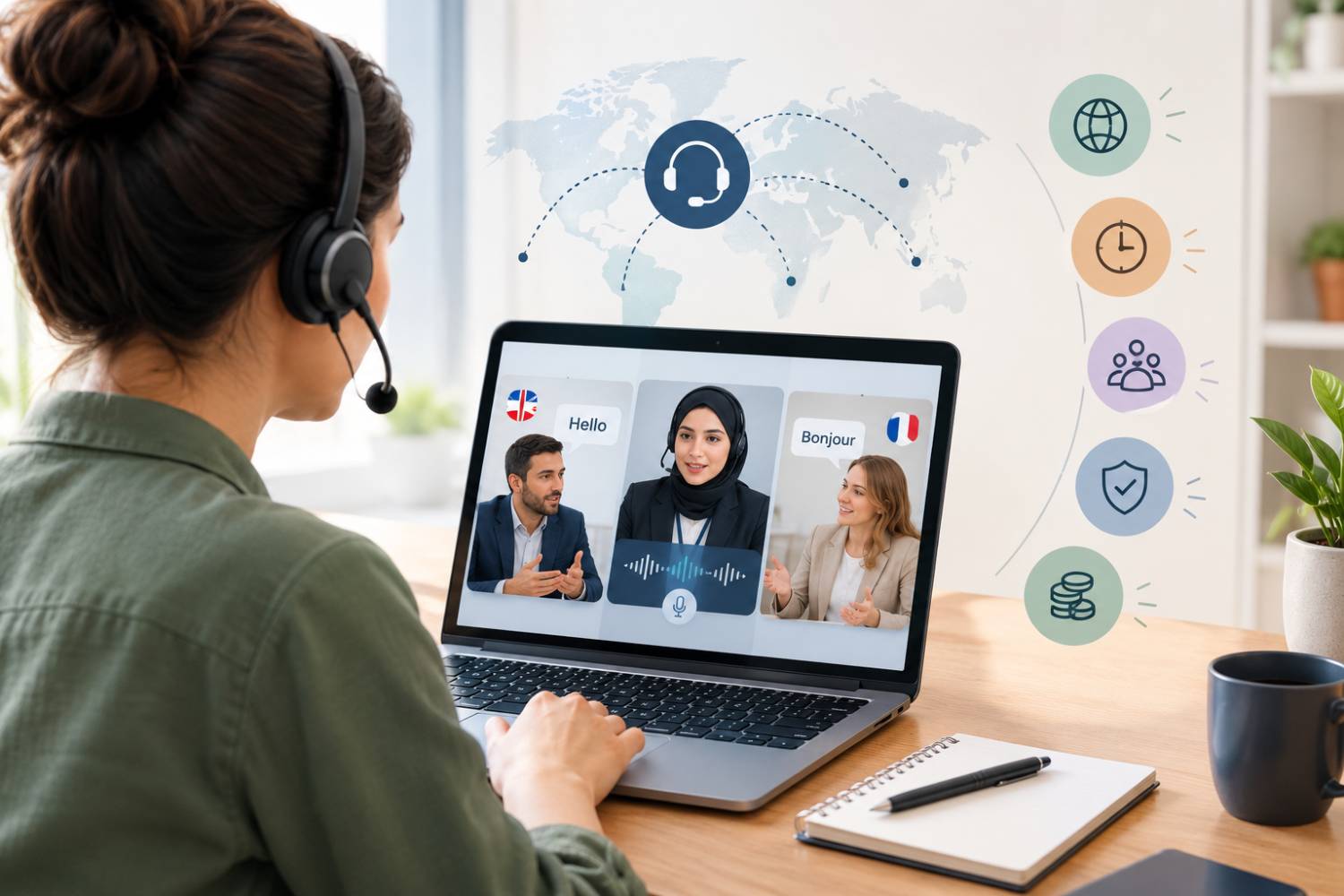
Video remote interpretation uses a video conferencing platform or specialised service to connect participants with an interpreter. Participants can see one another while speaking, allowing them to observe facial expressions, gestures, and other visual cues.
Video interpreting can be useful in medical consultations, assessments, meetings, and other situations where visual communication supports understanding. However, video does not replace the need for a qualified interpreter, and its effectiveness depends on the quality of the connection, the participants' environment, and the complexity of the discussion.
Both formats can support effective communication, but the most appropriate option depends on the purpose of the conversation, the languages involved, and the needs of the participants.
1. Access to Interpreters Regardless of Location
One of the most significant benefits of remote interpretation is that it removes many geographical barriers.
With in-person interpreting, the interpreter must travel to the location where the conversation takes place. This can be difficult when participants live in different cities, when appointments occur at short notice, or when a particular language is not widely spoken in the local area.
Read more: Spanish Interpreter Services
Remote services allow organisations to connect with interpreters who may be located elsewhere. This can expand access to language support and make it easier to find professionals with the appropriate language skills.
For example, a healthcare provider may need an interpreter for a patient who speaks a language that is uncommon in the surrounding community. Rather than searching exclusively for a local professional, the provider may be able to arrange a remote session with a suitable interpreter.
The same principle applies to businesses working with international clients, educational institutions supporting multilingual students, and organisations assisting people who have recently moved to another country.
Remote access can be especially valuable in rural areas and smaller communities where the availability of specialised interpreting services may be limited.
2. Faster Access to Language Support
Time can be an important consideration when communication cannot be delayed. Remote interpretation can reduce the time needed to coordinate an appointment because the interpreter does not have to travel to the meeting location.
Depending on availability, language requirements, and the provider's booking arrangements, an interpreter may be connected to a conversation within a relatively short period.
This can help organisations respond to unexpected communication needs, particularly when a scheduled appointment changes or an individual requires assistance outside normal planning arrangements.
For example, a customer service team may receive a call from someone who cannot communicate comfortably in the available languages. Remote interpreting can help the representative understand the customer's concern and explain the next steps.
Similarly, a clinic may need language support for a consultation that has been arranged at short notice.
However, immediate availability should not be assumed for every language or specialist subject. Rare languages, complex legal matters, and assignments requiring specific qualifications may require advance booking. Organisations should establish whether their provider offers on-demand access, scheduled sessions, or both.
3. Reduced Travel and Coordination Costs
In-person interpreting may involve travel expenses, transport arrangements, and additional time for the interpreter and the organisation. Depending on the assignment, there may also be minimum booking periods or other logistical costs.
Remote interpretation can reduce some of these expenses because the interpreter joins the conversation electronically.
Potential savings may include:
Interpreter travel and transport costs.
Time spent coordinating in-person attendance.
Venue and meeting logistics associated with bringing participants together.
Delays caused by travel or scheduling conflicts.
Some administrative work associated with arranging physical appointments.
These savings can be particularly relevant for organisations that require interpreting regularly across multiple locations.
Nevertheless, remote interpretation is not automatically less expensive in every situation. Providers may charge per minute, per hour, or according to the assignment's complexity. Video technology, specialist language requirements, minimum booking periods, and platform subscriptions may also affect the total cost.
Before choosing a service, organisations should compare the full cost of remote and in-person interpreting rather than considering the interpreter's fee alone.
4. Greater Scheduling Flexibility
Remote interpretation makes it easier to coordinate conversations between people who have different schedules or work in different time zones.
An organisation can arrange a video call or telephone session without requiring the interpreter to travel to a particular office or facility. This can make it easier to accommodate international business meetings, remote consultations, and appointments involving people who live far apart.
For example, a company based in the United Kingdom may need to speak with a supplier in another country. Remote interpreting allows the participants and interpreter to join the same meeting from their respective locations.
This flexibility can also support people with mobility limitations, individuals who find travel difficult, and those who need to attend appointments from home.
However, scheduling flexibility depends on the provider's operating hours and interpreter availability. If a meeting involves several time zones, organisers should confirm the local time for every participant and allow sufficient time for interpreting.
Read more: German Interpreter Services
5. Improved Access to Specialist Language Support
Not every interpreting assignment requires the same expertise. A casual conversation, medical appointment, legal consultation, and technical business meeting may involve very different terminology and communication requirements.
Remote services can make it easier to search for an interpreter with the appropriate language combination and relevant experience, even when that professional is not based nearby.
For instance, a patient may need an interpreter who understands medical terminology, while a solicitor may require someone experienced in legal proceedings. A company discussing technical specifications may need an interpreter who can accurately communicate industry-specific concepts.
Remote access can expand the available pool of professionals, but organisations must still verify qualifications and experience. General fluency in two languages does not necessarily mean that an interpreter is equipped to handle every specialist assignment.
When selecting a provider, it is important to explain the subject, expected terminology, participants' languages, and any professional or regulatory requirements in advance.
6. Better Access to Healthcare Communication
Healthcare is one area where language barriers can have significant consequences. Patients need to understand questions about their symptoms, medical history, treatment options, medication, and follow-up instructions. Healthcare professionals also need to understand patients' responses accurately.
Remote interpreting can help healthcare providers communicate with patients who do not speak the language used by the medical team.
Telephone interpreting may be appropriate for straightforward conversations, while video interpreting can be helpful when visual cues contribute to the consultation. The choice depends on the clinical context, the patient's needs, and the availability of appropriate services.
Potential benefits include:
Easier access to language support for appointments.
Improved communication about symptoms and medical history.
Better understanding of treatment instructions.
Reduced need to postpone appointments while searching for an in-person interpreter.
Greater access to language support in locations with limited local resources.
Remote interpreting does not replace medical professionals or guarantee that a patient will understand every aspect of their care. Healthcare providers should confirm comprehension, explain unfamiliar terms, and follow their own clinical and safeguarding procedures.
For sensitive or complex consultations, they should also assess whether remote interpreting is appropriate or whether an in-person arrangement would better meet the patient's needs.
7. Support for International Businesses
Businesses increasingly work with customers, suppliers, employees, and partners from different linguistic backgrounds. Language barriers can complicate negotiations, project discussions, onboarding, customer service, and international expansion.
Remote interpretation allows participants to hold multilingual meetings without bringing everyone to the same physical location.
For example, a company negotiating a supply agreement with an overseas partner can arrange a video meeting with an interpreter who understands the relevant commercial terminology. The participants can discuss requirements, clarify questions, and identify points that need further negotiation.
Remote interpreting can also support training sessions, employee interviews, customer consultations, and discussions about product specifications.
Its value is particularly clear when businesses need language support across several locations. Instead of arranging separate in-person sessions, a company may be able to coordinate meetings through a single remote setup.
To achieve reliable results, organisers should share agendas and relevant terminology in advance, use stable communication technology, and allow pauses for interpretation. For complex negotiations, professional interpreting should be considered alongside appropriate legal or commercial advice.
8. Greater Accessibility for People With Different Needs
Remote interpretation can make communication more accessible for individuals who face barriers to attending in-person appointments.
People with mobility limitations, caring responsibilities, transport difficulties, or demanding work schedules may find remote appointments easier to attend. They can often connect from a familiar location, provided they have the necessary technology and a suitable environment.
Remote interpreting may also help organisations support individuals who live far from service centres or who cannot easily travel to an office.
Read more: Interpreter Services in UK
However, accessibility depends on the design of the service. Not everyone has reliable internet access, a suitable device, a private space, or the digital skills needed to use video conferencing software.
Organisations should offer clear joining instructions, test the technology when possible, and consider telephone interpreting or in-person alternatives when video is not suitable.
The goal should be to remove communication barriers rather than replace one barrier with another.
9. Support for Education and Public Services
Schools, universities, local authorities, and community organisations frequently communicate with people who speak different languages.
Remote interpretation can support meetings with parents, student consultations, service assessments, administrative appointments, and explanations of policies or procedures.
For example, a university may need to discuss enrolment requirements or student support arrangements with an international student. A remote interpreter can help both parties understand the conversation without requiring the student to travel to another location.
Public service organisations may also use remote interpreting to explain processes, gather information, or help individuals access available services.
The suitability of remote interpreting depends on the sensitivity and complexity of the discussion. Meetings involving safeguarding, confidential personal information, or complex decisions may require additional planning and specific professional arrangements.
10. Improved Privacy in Certain Situations
Some individuals feel uncomfortable discussing sensitive matters in front of an unfamiliar person who is physically present. Depending on the circumstances, remote interpreting may make it easier for participants to feel more at ease.
For example, a person attending a consultation from a private room may prefer a remote interpreter rather than having another individual physically present. Remote arrangements can also help organisations access interpreters without requiring them to enter restricted workplaces or facilities.
However, remote interpreting does not automatically provide greater confidentiality. Telephone calls and video meetings can be overheard, recorded, or exposed through insecure technology if appropriate safeguards are not in place.
Organisations should use suitable platforms, restrict access to authorised participants, explain recording policies, and establish how personal information will be handled. Interpreters should follow applicable professional confidentiality requirements.
Participants should also choose a private environment and avoid discussing sensitive information where other people can hear the conversation.
11. Easier Support for Multiple Languages
Organisations serving multilingual communities may need interpreting in several languages, sometimes within the same day.
Remote services can make it easier to coordinate different language combinations without relying exclusively on interpreters who live nearby. This is useful for hospitals, customer support teams, universities, public services, and international businesses.
For example, a service provider may need to assist one person who speaks Spanish in the morning and another who speaks Polish later in the day. Remote access can expand the options available for matching each person with an appropriate interpreter.
Organisations should still confirm the interpreter's language proficiency and experience for each assignment. They should not assume that a provider can supply every language immediately or that all interpreters have the same specialist qualifications.
12. Continuity of Communication During Disruptions
Unexpected events can affect travel, office access, and the ability to attend appointments in person. Remote interpretation provides an alternative when participants cannot meet at the same location.
Depending on the circumstances, it can support communication during transport disruptions, severe weather, temporary workplace closures, or changes to an organisation's operating arrangements.
It can also help organisations continue serving clients when staff work across different locations.
Nevertheless, remote interpreting depends on electricity, connectivity, suitable devices, and access to the service provider. Organisations should have contingency plans for technical failures, particularly when communication is urgent or time-sensitive.
Challenges and Limitations of Remote Interpretation
Although remote interpreting offers many advantages, it is not the ideal solution for every conversation. Understanding its limitations helps organisations make informed decisions.
Technical Problems
Poor internet connections, delayed audio, background noise, and malfunctioning equipment can interrupt communication. Participants should use reliable devices, test their microphones, and minimise background noise before the session.
For important meetings, a backup telephone number or alternative connection method can reduce the impact of technical problems.
Limited Visual Information
Telephone interpreting does not allow participants to see facial expressions, gestures, or visual materials. Even video interpreting may make these cues difficult to observe if the camera angle or connection quality is poor.
Where visual communication is important, organisers should consider video rather than telephone interpreting and ensure that everyone can see and hear clearly.
Reduced Suitability for Certain Sensitive Assignments
Some conversations require a high level of personal interaction, detailed observation, or additional support. In-person interpreting may be more appropriate for certain clinical consultations, complex assessments, or sensitive interviews.
The decision should be based on the needs of the participants, the nature of the discussion, and any relevant professional requirements.
Confidentiality and Data Security
Remote sessions may involve personal, medical, legal, or financial information. Organisations must consider the security of their communication platforms, access controls, data handling practices, and any recording arrangements.
Before selecting a provider, ask how confidential information is protected and whether the service meets the requirements relevant to the assignment.
Maintaining Accuracy During Complex Conversations
Remote interpreting can be demanding when several people speak at once, when participants use specialist vocabulary, or when a conversation moves quickly.
Organisers should establish basic communication rules, avoid interruptions, and allow the interpreter time to communicate each statement. For lengthy or complex assignments, advance preparation can improve accuracy.
How to Choose a Reliable Remote Interpretation Provider
Choosing an appropriate provider involves more than finding someone who speaks the required languages. The interpreter must be suitable for the subject, the communication format, and the needs of the participants.
Consider the following factors before booking:
Language availability: Confirm that the provider can supply an interpreter for the required language and dialect.
Relevant experience: Ask whether the interpreter has experience in the relevant setting, such as healthcare, legal services, business, or education.
Availability: Check whether the service offers scheduled appointments, on-demand access, or support outside standard working hours.
Interpreting format: Decide whether telephone or video interpreting is more appropriate for the conversation.
Professional standards: Ask about interpreter qualifications, confidentiality policies, and any relevant professional codes of conduct.
Technology and support: Confirm that the platform is easy to use and that technical assistance is available if connection problems occur.
Pricing and booking conditions: Understand the charging structure, minimum session duration, cancellation terms, and any additional fees.
Special requirements: If the assignment is connected to an official procedure, confirm whether the relevant authority accepts an independently arranged remote interpreter.
A service directory such as Hebosa can help people explore interpreting options for different language and professional needs. The key is to match the interpreter's skills and experience to the specific conversation rather than choosing a service based on availability alone.
Tips for Getting the Most From a Remote Interpreting Session
A few practical steps can improve the quality of communication and help the session run smoothly.
Share the purpose of the meeting in advance. Explain the subject, participants, and expected terminology so the interpreter can prepare appropriately.
Check the connection before starting. Test the microphone, speakers, camera, and internet connection when using video.
Speak clearly and naturally. Avoid speaking too quickly or using unnecessary jargon.
Allow pauses for interpretation. Participants should speak in manageable sections and avoid talking over one another.
Use names and technical terms carefully. Spell unfamiliar names, numbers, and place names when necessary.
Ask for clarification. If something is unclear, pause and resolve the misunderstanding before moving forward.
Protect privacy. Use a quiet, private space and follow the agreed rules for confidential information.
Confirm important details. Summarise key decisions, deadlines, and next steps to ensure everyone has understood them.
These practices are useful across healthcare, business, education, legal consultations, and other settings where accurate multilingual communication matters.
Conclusion
Remote interpretation services have made professional language support more accessible to individuals and organisations that need to communicate across language barriers. By connecting participants through telephone or video technology, they can reduce geographical restrictions, improve scheduling flexibility, limit certain travel expenses, and expand access to interpreters with relevant language skills.
Their benefits extend across healthcare, business, education, public services, and international communication. However, successful remote interpreting depends on selecting an appropriately qualified professional, using reliable technology, protecting confidential information, and choosing a format that suits the conversation.
Remote interpretation is not a universal replacement for face-to-face services. Instead, it provides a flexible option that can complement in-person interpreting and help organisations respond to a wider range of communication needs.
When the service is selected carefully and participants prepare properly, remote interpreting can make multilingual conversations clearer, more accessible, and easier to coordinate.
Frequently Asked Questions
1. What are the main benefits of remote interpretation services?
The main benefits include access to interpreters regardless of location, faster scheduling in some circumstances, reduced travel and coordination costs, greater flexibility, and access to a wider range of language combinations. Remote interpreting can also help organisations support people across multiple locations.
2. What is the difference between telephone and video interpretation?
Telephone interpretation uses audio communication and is often suitable for straightforward conversations where visual information is not essential. Video interpretation allows participants to see one another, which can be useful when facial expressions, gestures, or visual context support communication.
3. Are remote interpretation services suitable for medical and legal appointments?
They can be suitable for many medical and legal appointments, provided the interpreter has the appropriate experience and the format meets the needs of the assignment. Some complex or sensitive situations may be better served by in-person interpreting. Organisations should also check applicable professional and regulatory requirements.
4. Are remote interpretation services confidential?
Professional interpreters are generally expected to follow confidentiality requirements, but privacy also depends on the platform, the organisation's procedures, and the environment in which the call takes place. Users should confirm the provider's policies, use secure communication methods, and choose a private location.
5. How do I choose the right remote interpretation service?
Identify the required language and dialect, the subject of the conversation, and whether telephone or video interpreting is appropriate. Then check the interpreter's relevant experience, availability, professional standards, privacy practices, technology, and pricing. If the appointment is part of an official process, confirm any specific interpreter requirements before booking.


